Academic Project
The Gutter Defender addresses critical safety and accessibility challenges homeowners and professional services face when cleaning second-story gutters. With a multidisciplinary team, I led the development of an innovative spring-loaded mesh guard system that enables safe, efficient gutter maintenance from the ground level. Through comprehensive user research, iterative prototyping, and rigorous testing, we created a solution that eliminates the need for dangerous ladder climbing while providing superior cleaning performance and real-time gutter visibility.
Our team was challenged to uncover a white space and develop a solution.
We connected with California homeowners facing two key challenges: clogged gutters posing serious fire risks in drought-prone regions and insurance companies using drones to monitor gutter maintenance, potentially canceling coverage due to debris accumulation.
These concerns pointed to a significant white space opportunity in home maintenance. Over 50,000 Americans are injured annually in ladder-related accidents, with gutter cleaning representing a primary cause. Professional services often refuse second-story work due to liability concerns, leaving homeowners with dangerous DIY solutions or expensive alternatives.
We conducted in-depth interviews with homeowners and professional service providers to understand the challenges surrounding gutter maintenance. Through direct observation and journey mapping, we found that existing solutions (extended pressure washers, telescoping brushes, and static mesh guards) consistently failed to meet users’ needs for safety, reach, visibility, and effectiveness.
Through comprehensive brainstorming, our team generated six distinct solution categories: extendable poles, drones, retractable scrapers, remote-controlled cars, emptiable baskets, and window-based tools.
Using systematic alternative matrices, we evaluated each concept against critical performance requirements - safety, reach, visibility, cleaning effectiveness, and ease of use. The emptiable mesh basket concept emerged as the most promising solution.
We developed three prototype iterations, each incorporating user feedback and performance improvements.
Ground-level proof of concept that validated debris removal but lacked automatic reset functionality.
Added spring-loaded mechanism for automatic mesh guard return and conducted testing on Northwestern's Ford balcony, achieving 96.3% removal of dry debris.
Scaled to full 10-foot gutter length with enhanced cord durability and ergonomic handle, tested with both dry and wet debris to simulate real-world conditions.
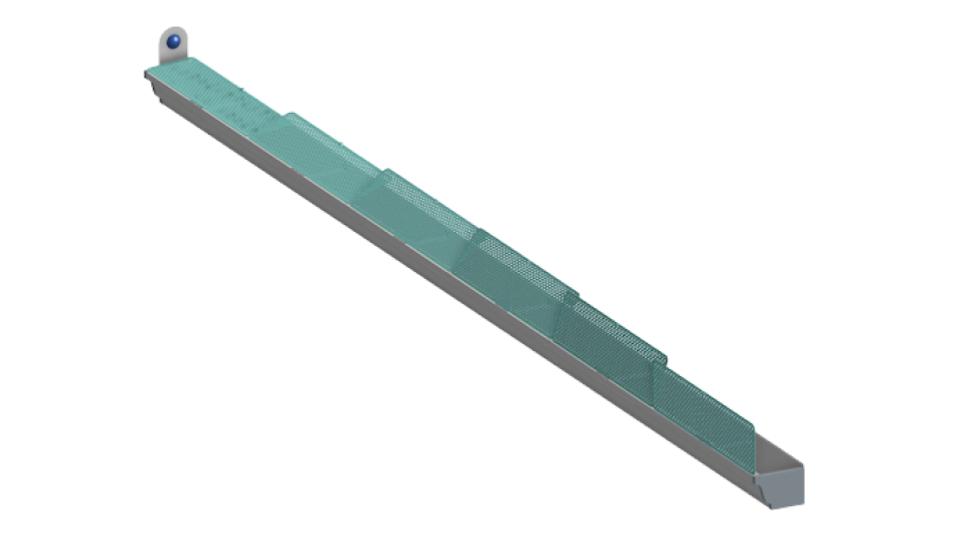
The final design combines three integrated components: a spring-loaded mesh guard that flips downward to release debris, a ground-level pull-cord system with an ergonomic handle, and a solar-powered inspection camera with mobile app connectivity. Installed along the entire length of the gutter, the system enables users to clear accumulated debris in seconds with a simple pull-and-release action.
We conducted comprehensive functional and user testing across two iterations with 10+ participants. Our solution achieved:
Our financial analysis identified a viable market opportunity among homeowners in fire-prone regions, with a projected retail price of $99–$149.
We also explored potential partnerships with insurance companies, home improvement retailers, and fire safety organizations. Opportunities for future development include aesthetic refinements, smart home integration, and enhanced user feedback systems.
I’m particularly proud of our team’s commitment to ethical engineering and to prioritizing user safety, environmental sustainability, and accessibility throughout the design process. This experience also strengthened my passion for using design to create thoughtful solutions that address real-world challenges and improve people’s everyday lives.
