Senior Capstone Project
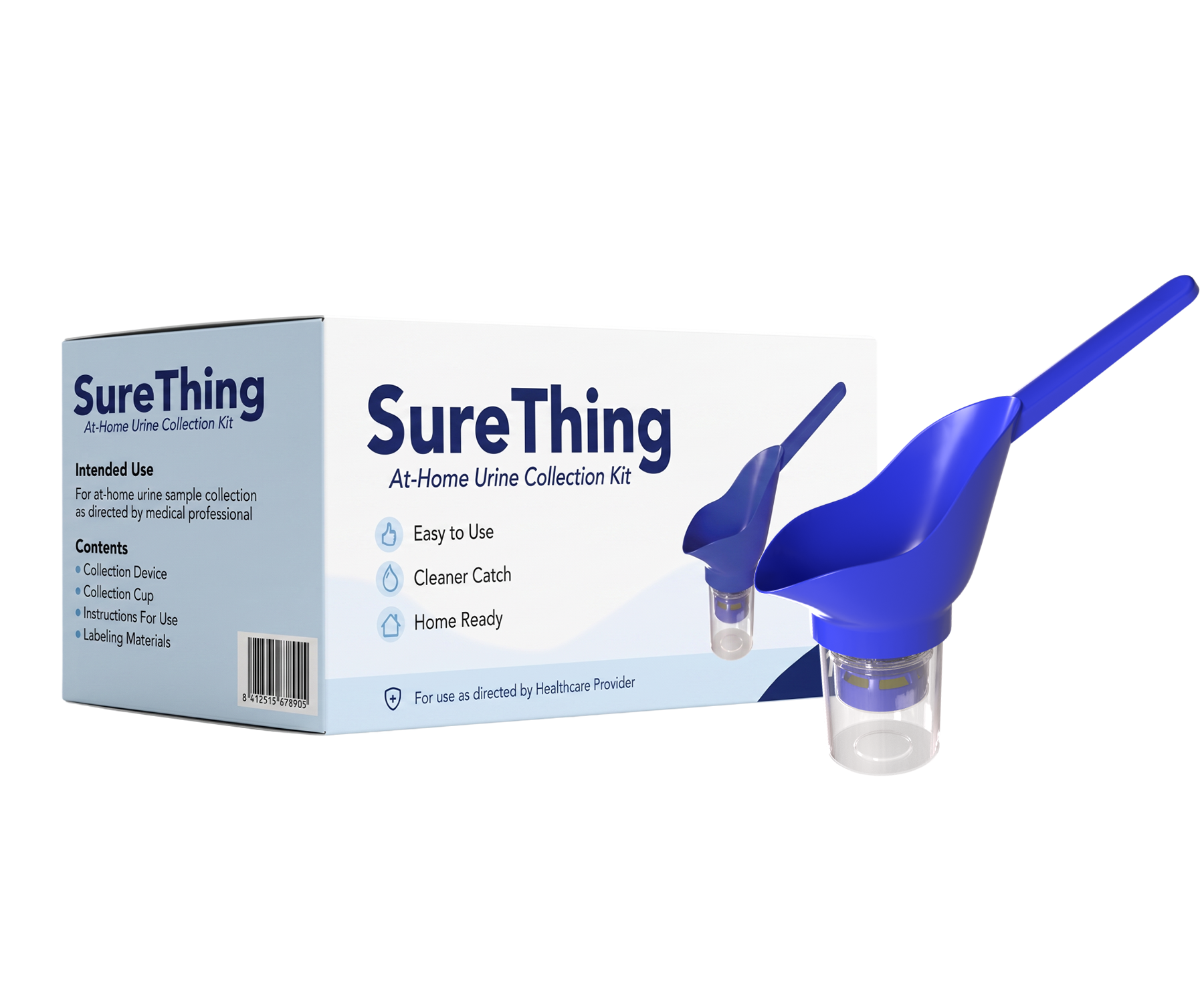
SureThing is a handheld midstream urine separator that attaches to a standard urine collection cup. For many women, the current standard cup and midstream clean-catch urine collection procedure can feel awkward, unsanitary, and physically difficult to perform. These usability challenges also have clinical consequences. When patients struggle to follow collection instructions, samples are more likely to become contaminated, leading to unclear results, additional testing, supplemental costs, and unnecessary medical waste.
Our team was challenged with reimagining the urine collection procedure for women by designing a device that was easier to position, more hygienic, and intuitive to use while improving sample accuracy and remaining compatible with existing clinical workflows.
The project began with a single survey response. One participant shared that providing a urine sample as a woman could be challenging, raising the question of whether this was an isolated experience or a broader issue. To investigate further, I designed and distributed a more comprehensive survey to college-aged women across the Northwestern community.
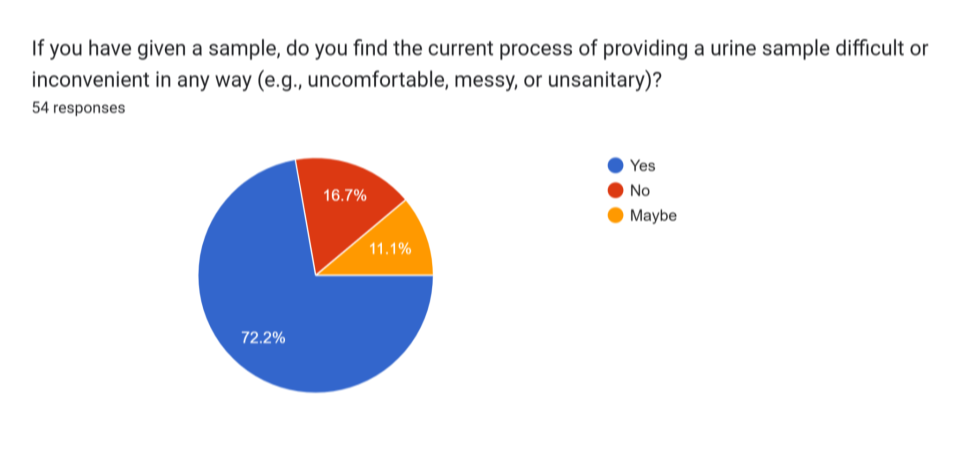
Of the 54 women who responded, 73% answered "Yes" to the question:
"Do you find the current process of providing a urine sample difficult or inconvenient in any way, such as being uncomfortable, messy, or unsanitary?"
We also reached out to physicians at Northwestern University's Feinberg School of Medicine, where we learned that the standard urine collection cup is often ineffective at obtaining uncontaminated urine samples for UTI testing. Currently, the most common collection method used in clinical settings is the midstream clean-catch technique, which requires patients to discard the initial portion of the urine stream into the toilet before collecting the midstream sample in a cup.
To better understand why standard urine collection cups can be uncomfortable and difficult to use, I led user interviews and usability testing with college-aged women. Participants used a standard urine collection cup before reflecting on their experience, revealing four key pain points:
Participants also evaluated five existing urine collection devices. Their feedback revealed that funnel-shaped designs increased confidence when aiming, while handles made devices easier to position.
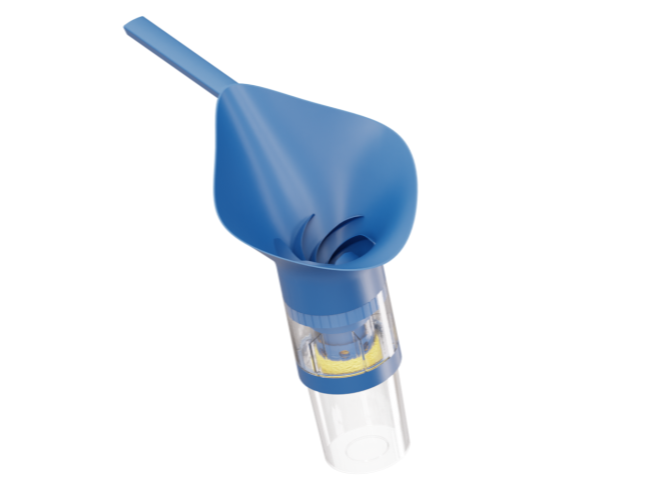
Based on these insights, we developed the first prototype of SureThing, a handheld midstream urine separator that attaches to a standard urine collection cup. The device automatically separates the initial urine stream from the midstream sample while providing a more comfortable collection experience.
Guided by user feedback, we incorporated a funnel to improve aiming and a handle to provide greater comfort and control during use.

To evaluate comfort with our first prototype, I conducted usability tests in which participants interacted with the design and shared feedback, revealing three key insights:
Based on this feedback, we shortened the device and reduced the width of the funnel to improve comfort and ease of positioning.
After implementing design changes, we conducted another round of usability testing, finding that participants considered the revised prototype easier to position and more intuitive to use.
These findings validated that the revised design addressed the users' needs.
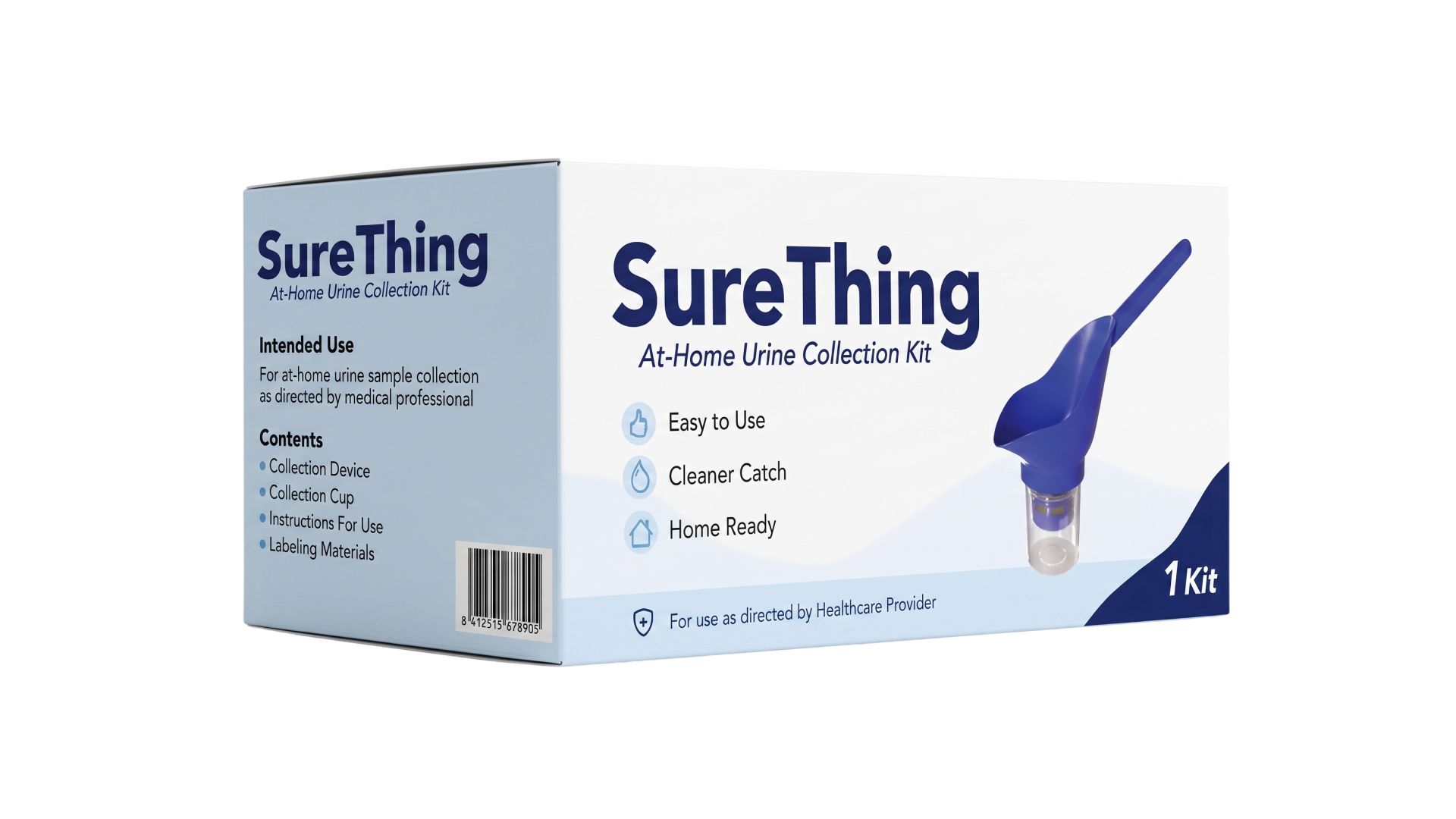
To develop SureThing's brand identity, I benchmarked existing medical products, including Cologuard and Tampax, to understand how established brands use color, layout, and messaging to build trust and communicate clarity.
To name the product, I facilitated a team brainstorming workshop, asking each member to generate words that captured the functional benefits, emotional impact, and desired user experience we wanted the product to convey. Using these themes, we generated and evaluated potential names before selecting SureThing. We chose SureThing because it reflects the product’s core value proposition: making it easier to collect an uncontaminated urine sample while conveying the sense of comfort and reassurance we wanted users to feel throughout the collection process.
For the packaging, I selected a two-tone blue palette because blue is widely used in healthcare to communicate trust, safety, cleanliness, and reliability. We intentionally avoided stereotypically feminine colors and any colors that evoke urine to create a brand that felt clinical and professional.
Overall, the visual identity reflects SureThing's goal of creating a more comfortable and confident urine collection experience for women.

We presented our final product to faculty from Northwestern's Segal Design Institute, part of the McCormick School of Engineering & Applied Science, and fellow Northwestern students.
For our work, the team received the Breaking Glass Award, presented only twice in the past five years to the capstone that best exemplifies the design process. Looking ahead, we hope to license the design to a medical device company.
The article “SureThing Solves a Messy Problem” is featured on Northwestern’s Segal Design Institute website. Read the article here.
This capstone project provided firsthand experience navigating the full product design process. I spent my senior year developing the project, contributing to every stage - from initial research and prototyping to testing, iteration, and patenting. Seeing the project evolve through each stage reinforced the importance of every step in bringing a concept to life.
